

Connect an API That Is Not in the Catalog
A custom integration lets Decisional agents work with an API that does not already have a built-in integration. Give Dex the API documentation, explain what the agent needs to do, and provide a test credential when the API requires one. Dex builds and tests the tools for you. You do not need to write the integration code yourself. A clear API reference and a working way to authenticate are usually enough to get started.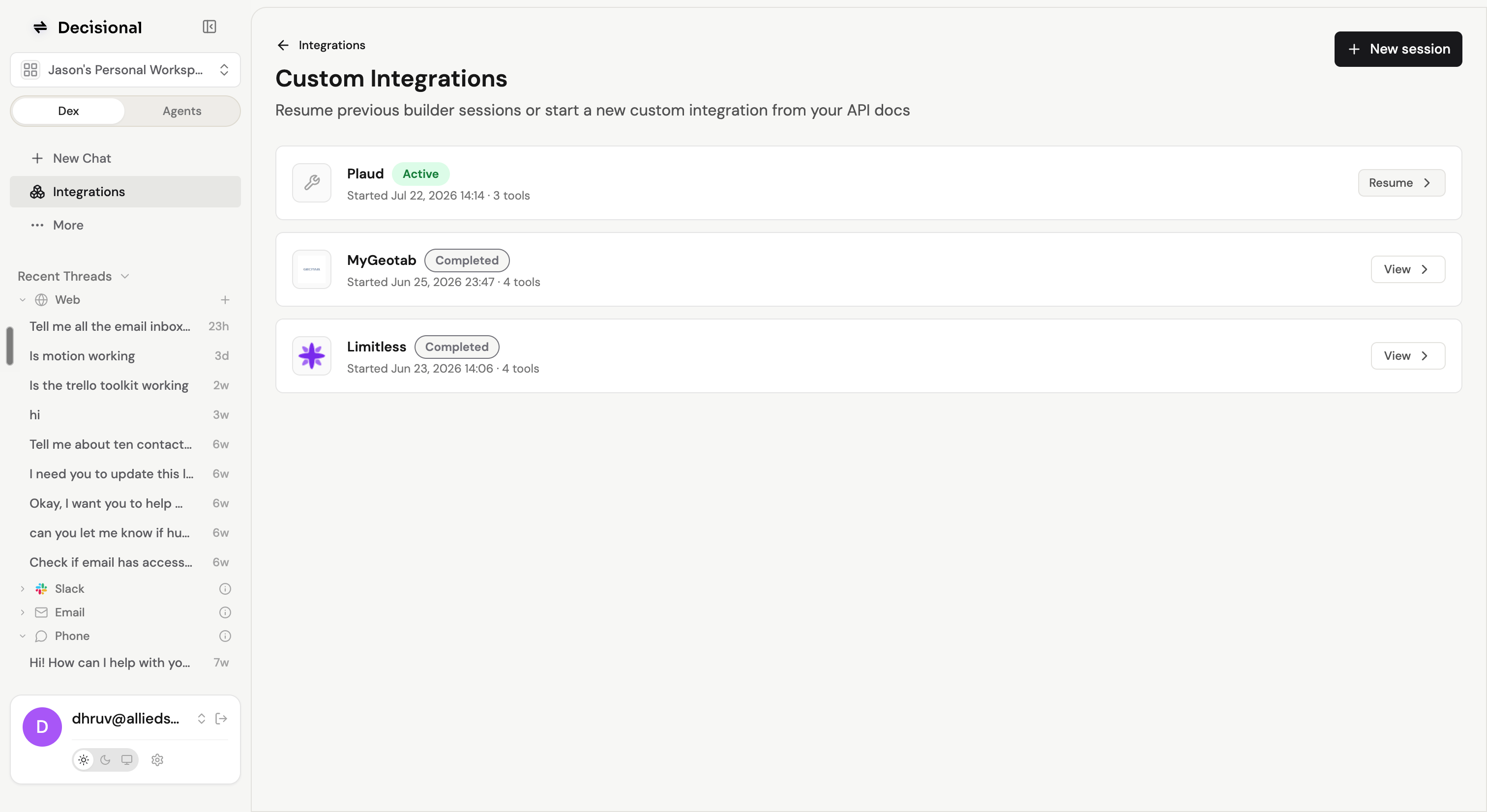
Custom Integration sessions can be resumed while they are active or reviewed after they are completed.
- A developer documentation URL
- An OpenAPI or Swagger specification
- A HAR export captured while using the service
- A cURL example or other request details
Custom integrations work best with documented HTTP APIs that Decisional can reach over the public internet. Private network addresses cannot be called from the builder.
Build a Custom Integration
Open Integrations, choose Custom Integrations, and select New session.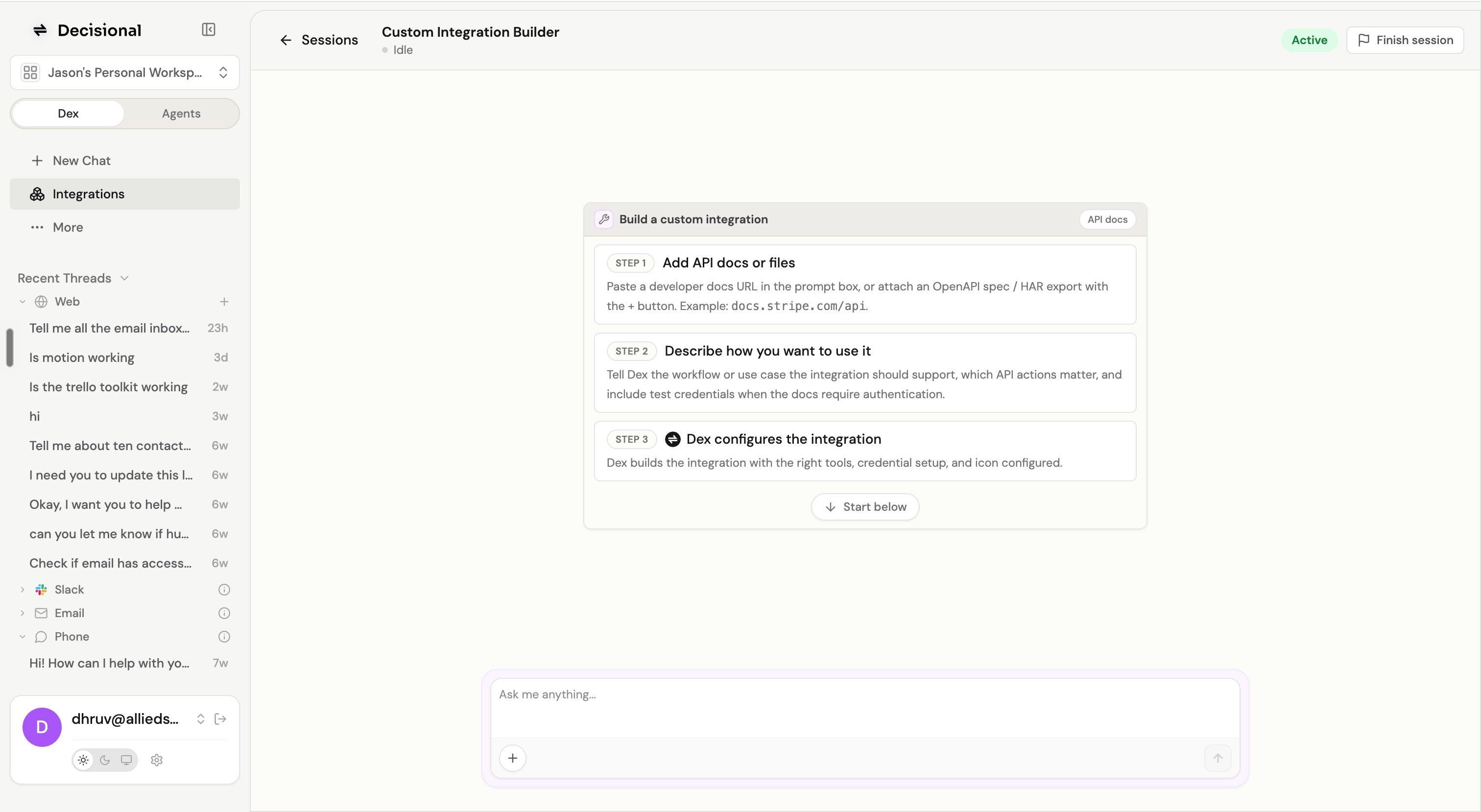
The builder asks for the API source, the use case, and any test authentication it needs before Dex configures the integration.
1
Add the API documentation
Paste the developer documentation URL into the message box. If the documentation is in a file, use the + button to attach an OpenAPI specification or HAR export.
2
Describe the result you need
Tell Dex what the agent should read, create, update, or send. Name the few API actions that matter to your workflow instead of asking for every endpoint at once.
3
Provide a test credential
If the API requires authentication, provide a working test API key or the requested test account details. Dex uses it to replay a real request, confirm the authentication method, and test each tool.
4
Review the tools Dex creates
Dex starts with a useful read-only action, tests its response, and then adds the remaining actions. Each action becomes a named tool with clear inputs and outputs.
5
Connect the account
When the integration card appears, select Connect. Enter the credential fields Dex configured, such as an API key, base URL, account ID, or region. This is the credential the agent will use after setup.
6
Finish the session
Select Finish session when the tools and credential setup are correct. The integration remains available on your organization’s Integrations page and can be added to agents.
What Dex Creates
Dex turns the API into the same building blocks used by other Decisional integrations:
Read tools only look up information. Write tools create or change something in the external system and are marked separately so your normal approval policy can protect them.
Tell Dex Exactly What You Need
A useful request includes the documentation, authentication method, desired actions, and one safe example to test.API Keys and Other Credentials
The builder needs a working test credential to prove that the integration works. Use a separate, low-permission test key when possible. During the builder session, Dex uses the test value only to test requests and the authentication check. It does not place the secret in the tool code, the integration description, or the credential form definition. After the integration is created, connect the account through the generated Connect form. Do not paste API keys into agent instructions or workflow nodes. The tools read the selected credential securely when they run.Sessions and Sharing
Each builder session creates one integration.
The session history is private to its creator. The custom integration itself belongs to the organization, so other organization members can find it on the Integrations page, connect their permitted credentials, and add its tools to agents.
Use the Integration in an Agent
After connecting the integration:- Open an agent and unlock it to create an editable Draft if needed.
- Ask Dex to add the custom integration and name the tools the workflow should use.
- Open the integration in the right-hand panel and map a credential to each tool.
- Test the agent with a small example.
- Inspect the run and confirm each node received and returned the expected data before publishing.
Agent Instructions
Learn how integrations, tools, and credentials are shown and mapped in an agent.
Credentials
Learn how connected accounts and tool credentials are managed.